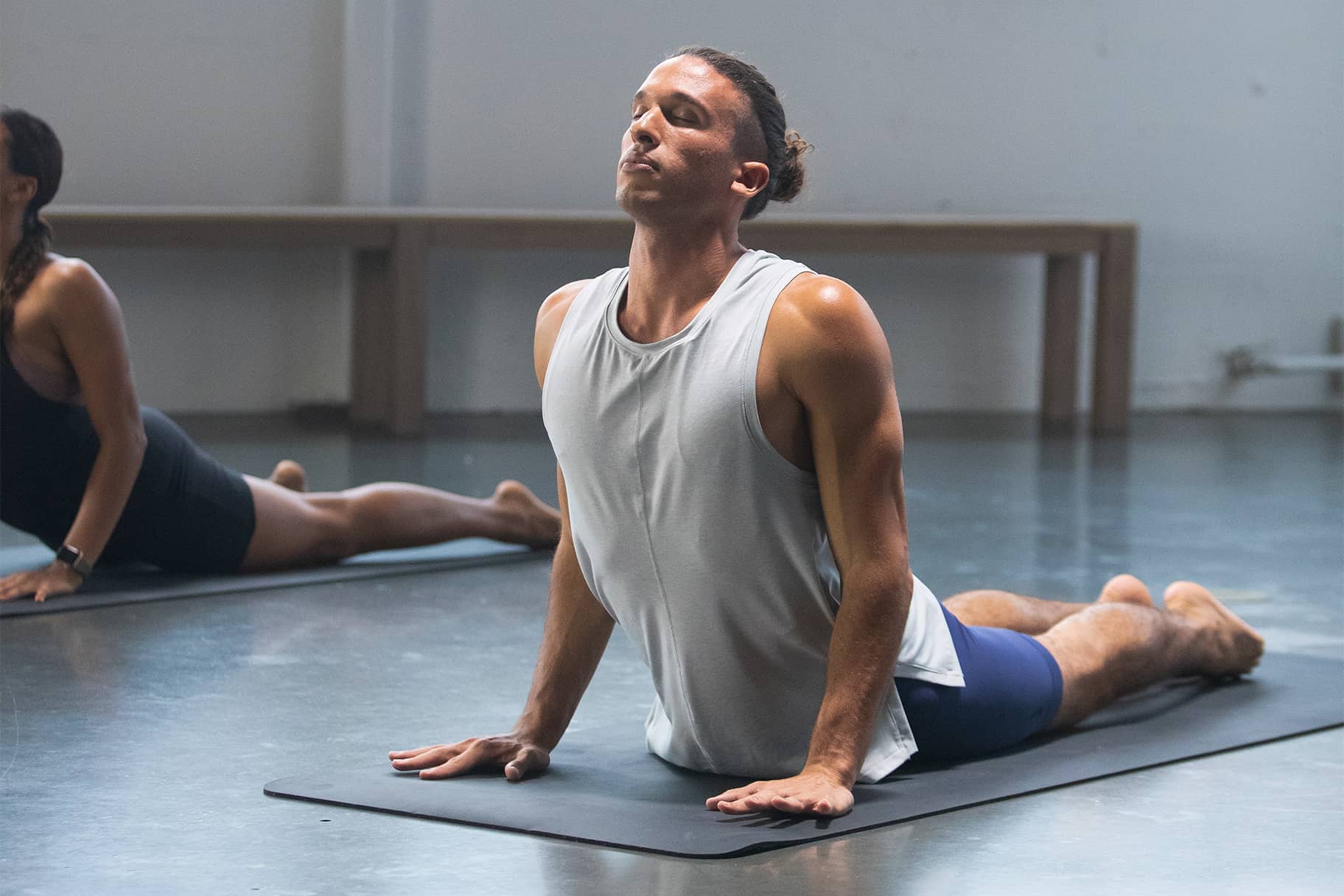
Grace could fold herself into a full split. She’d been doing yoga three mornings a week for six years, ran two half-marathons a year, and had, by any conventional measure, one of the more enviable fitness routines among her friends. So it made no sense to her that she was the one lying flat on her physiotherapist’s table for the third time in eighteen months, having thrown out her lower back lifting a suitcase off the floor — the kind of ordinary, unremarkable movement she should have been able to do without a second thought.
What made it stranger was her neighbor, Walter. Walter was sixty-three, had never set foot in a gym in his life as far as she knew, and spent most weekends hauling mulch bags around his garden, hoisting his grandkids onto his shoulders, and getting up off the ground — knees, not hands — without so much as a grunt. He didn’t look particularly fit. He wasn’t lean or muscular in any visible way. And yet his body simply worked, in a way Grace’s increasingly didn’t.
She found herself watching him over the fence one Saturday, half-annoyed, half-genuinely puzzled. She had done everything the fitness world told her to do. She was flexible. She was aerobically fit. She ate reasonably well. So why did her body keep failing her at the exact moments that mattered — the awkward lift, the sudden twist, the unglamorous real-life movement — while a man twenty years older, with no visible training regimen at all, moved through his days like nothing could touch him?
There was something going on with Walter that had nothing to do with how hard either of them was working. Grace just couldn’t yet see what it was.
The Gap Between Looking Fit and Actually Functioning
There is a quiet failure happening in a lot of gyms, living rooms, and yoga studios right now. People train consistently, sometimes for years, and still find that everyday movement — getting up off the floor, reaching for something on a high shelf, carrying groceries up two flights of stairs without the lower back complaining — feels harder than it should. The numbers on paper look fine. The mirror, depending on the week, looks fine too. But the body itself doesn’t feel like a reliable instrument. It feels like something to manage rather than something to live in.
This is the gap between fitness as appearance and fitness as function. And at the center of that gap sit two qualities that get far less attention than they deserve: flexibility and muscle mass.
Not flexibility in the sense of a party-trick split. Not muscle mass in the sense of size for its own sake. Flexibility as the range through which your joints can move safely and efficiently. Muscle mass as the structural and metabolic tissue that lets your body produce force, protect its joints, and keep functioning well into the decades where most people quietly start to decline. Together, these two qualities form what researchers and physical therapists call functional fitness — the capacity to move through real life with strength, control, and resilience.
What Functional Fitness Actually Means
Functional fitness is not a style of workout. It is a description of outcome. A functionally fit body can squat down to pick something up and stand back up without strain. It can rotate, reach overhead, carry an awkward load, catch its balance on uneven ground, and recover from a minor stumble without injury. It can sit at a desk for hours and then get up without the lower back seizing.
This is different from the kind of fitness measured in a gym mirror or a one-rep max. You can have visible muscle and still move poorly — tight hips, a stiff thoracic spine, shoulders that can’t comfortably reach overhead. You can also be lean and aerobically fit, like Grace, and still lack the strength and control to get off the floor gracefully, which, troublingly, is one of the stronger predictors of longevity that exists in the research literature.
Functional fitness sits at the intersection of two physical capacities working together: the range of motion available at your joints, and the force-producing, structurally supportive tissue that controls and stabilizes that range. Neither one, on its own, is enough — which is precisely the trap Grace had fallen into without realizing it.
Flexibility: The Underrated Foundation That Isn’t the Whole Story
Flexibility refers to the ability of your muscles, tendons, and connective tissue to lengthen, and your joints to move through their full, intended range. It’s frequently dismissed as a “nice to have,” or on the other end, mistaken for the entire solution — as Grace had, unknowingly, spent years assuming.
Restricted flexibility narrows everything else. When the hip flexors are chronically tight, the glutes don’t fire properly, forcing the lower back to compensate during ordinary movements like standing up or climbing stairs. When the thoracic spine loses rotation, the shoulders pick up the slack — a significant contributor to shoulder impingement. Flexibility deficits don’t stay where they start. They cascade.
But flexibility without control is its own liability. A very flexible body has access to a wide range of motion but, without the muscular strength to stabilize that range, is exposed at exactly the end points where joints are most vulnerable — the deep stretch, the sudden twist, the awkward lift. This is closer to what was actually happening to Grace than she initially understood.
It’s one of the most reliable predictors of how well your body ages. Joint range of motion tends to decline steadily after the mid-30s if it isn’t actively maintained, and that decline is one of the quieter mechanisms behind the loss of independence many people experience later in life — not from a single dramatic event, but from a slow erosion of the ability to move freely.
Muscle Mass: Far More Than an Aesthetic Goal
Muscle mass has an image problem. Cultural framing tends to position it as something pursued for appearance — bigger arms, a more defined physique — which obscures what muscle tissue is actually doing for the rest of the body. It’s also the piece Grace’s routine had been quietly under-building for years, buried beneath the more visible priority of staying lean and limber.
It’s the structural support system for your joints. Strong muscles around the knee, hip, and shoulder absorb and distribute force that would otherwise land directly on cartilage, ligaments, and bone. Adequate muscle mass is one of the most effective forms of joint protection available — precisely why physical therapists prescribe strength training so consistently for injury recovery and prevention.
It’s metabolically active tissue. Muscle burns more energy at rest than fat tissue does, and it plays a central role in regulating blood sugar as a major site for glucose disposal. Declining muscle mass is closely linked to declining metabolic health, independent of body weight.
It’s one of the strongest known predictors of healthy aging. The medical term for age-related muscle loss is sarcopenia, and it begins earlier than most people assume — often in the 30s, accelerating significantly after 60 if nothing is done to counter it. Grip strength alone, a simple proxy for overall muscle mass, has repeatedly shown up in research as a meaningful predictor of long-term health outcomes. The people who maintain their ability to carry their own groceries, rise from a chair unassisted, and recover their balance after a stumble well into older age are, almost without exception, the people who maintained meaningful muscle mass — people like Walter.
It supports mental and emotional resilience too. Strength training has a well-documented relationship with reduced anxiety and improved mood, partly through the same neurochemical pathways involved in stress regulation. Emotional regulation and physical regulation are not separate systems — the body and the nervous system are in constant conversation, and building physical capacity is one of the more reliable ways to support both at once.
Why You Can’t Optimize for One and Neglect the Other
This is where most fitness approaches go wrong. They specialize. The strength-training crowd often treats flexibility as optional, accumulating tightness alongside muscle. The flexibility-and-mobility crowd — the world Grace had built her identity around — often under-trains strength, building impressive range of motion with too little tissue to stabilize and control it.
Both extremes produce a body that’s fragile in different ways. A very strong but inflexible body moves well within a narrow range and gets injured the moment life demands something outside it. A very flexible but under-muscled body has access to a wide range of motion but lacks the control to use that range safely — which is its own injury risk, particularly at end ranges.
Functional fitness requires both qualities developed together, not sequentially and not in isolation, but as a single, integrated capacity.
Why Yoga, Done a Certain Way, Builds Both at Once
Yoga has a branding problem in fitness culture. It’s frequently filed under “flexibility” or “relaxation,” treated as a complement to “real” training rather than a legitimate strength practice in its own right. That framing significantly understates what a well-structured yoga practice actually does to the body — and it’s the missing half of what Grace’s practice had been giving her.
Yoga builds strength through sustained, controlled bodyweight loading. Holding a plank, a chair pose, a warrior series, or a long-held downward dog is not passive stretching — it’s isometric and dynamic muscular work, often sustained for far longer than a typical strength-training repetition. Practiced consistently, yoga measurably increases muscular endurance and, particularly for beginners and intermediate practitioners, contributes meaningfully to strength gains.
It develops flexibility through active, controlled range rather than passive stretching alone. A static stretch lengthens tissue passively. Yoga asks the body to move actively through a full range while simultaneously controlling that range with muscular engagement — a quality sometimes called active flexibility, which transfers far more directly to real-world movement than passive flexibility does.
It trains the integration of strength and range simultaneously, which is exactly the combination functional fitness requires. A vinyasa flow moves the body through transitions that require strength to control a changing range of motion in real time — a remarkably accurate simulation of how the body is actually used in daily life: not in isolated single-plane movements, but in continuous, multidirectional sequences.
It improves balance and proprioception — the body’s internal sense of where it is in space — a quality that strength training and stretching alone don’t specifically target, and one that becomes increasingly important for fall prevention as people age.
It addresses the nervous system alongside the muscular system. A significant portion of adult flexibility restriction is not purely structural; it is protective tension held by a nervous system that has not been given permission to relax. Yoga addresses both the mechanical and the neurological components of that restriction at once.
Building a Practice: Training Flexibility and Muscle Mass Together
Choose a yoga style that matches your current need. Restorative and yin yoga, with long-held, passive poses, are excellent for deep flexibility work and nervous system regulation, but contribute relatively little to strength. Vinyasa, power yoga, and Ashtanga involve far more sustained muscular engagement and build genuine strength alongside range of motion.
Pair yoga with dedicated resistance training rather than treating it as a replacement. Yoga builds meaningful bodyweight strength, particularly in the upper body, core, and stabilizing musculature, but it doesn’t typically provide the progressive overload needed to build substantial muscle mass in the major lower-body and pulling muscle groups. Two or three sessions of resistance training a week — squats, hinges, presses, and pulls — combined with two or three yoga sessions, covers both ends of the functional fitness equation far more completely than either practice alone.
Prioritize the areas that restrict daily life the most, even if they aren’t the most comfortable to work on. For most adults living sedentary, desk-based lives, that means hip flexors, hip rotators, the thoracic spine, and the shoulders.
Track function, not just flexibility or strength in isolation. Can you get up off the floor without using your hands? Can you reach both arms overhead without your lower back arching to compensate? Can you carry something heavy and asymmetrical without your gait changing? These functional benchmarks are far more meaningful indicators of progress than how many degrees your hamstring can flex or how many kilograms you can lift in isolation.
Be patient with the process — and consistent with it. Flexibility gains are slow and require sustained, regular practice; muscle mass, similarly, builds over months, not weeks. Functional fitness is built the same way most durable things are built: incrementally, and over a long enough horizon that the gains genuinely compound.
What Grace Finally Learned From Walter
Grace eventually asked him, straight out, over the fence, half-expecting some secret supplement or a genetics answer that would let her off the hook. Instead, Walter told her something almost anticlimactic: after a knee surgery in his early fifties had scared him into taking his body seriously, he’d gone through a physical wellness consultation as part of a broader Success Path Assessment with an Acumentor mentor — not because he was chasing fitness, but because he wanted an honest picture of where his whole life actually stood.
What came back surprised him. His cardiovascular numbers were unremarkable, and he had no interest in changing that. But the assessment flagged something he’d never once considered: his functional strength — his ability to carry, lift, and stabilize his own body weight through ordinary movement — was quietly declining, even though nothing about his daily life felt hard yet. His mentor didn’t send him to a gym for aesthetics. He suggested something much simpler: a short, boring, twice-weekly practice combining strength-building yoga with basic resistance work, built specifically around the movements his actual life required — lifting, carrying, getting up off the ground.
He’d kept it going, unglamorously, for over a decade. Nobody noticed until it became the reason he could still do everything he wanted to.
Grace went home and, for the first time in six years of disciplined flexibility work, admitted that her routine might have been solving only half the problem. She scheduled her own consultation. What it surfaced wasn’t a flaw in her discipline — she had plenty of that. It was a blind spot: years of building range without building the muscle to control it, in a fitness culture that had taught her to measure flexibility and cardio and nothing else. Her mentor didn’t ask her to give up yoga. He asked her to add the piece she’d never been taught mattered.
Eight months later, she lifted the same suitcase off the same floor without thinking twice about it — not because her back had gotten lucky, but because she’d finally started training the half of her body that had been quietly working against her all along.
Functional Fitness Is a Wellbeing Issue, Not Just a Physical One
It’s tempting to file flexibility and muscle mass under “exercise” and leave it there. But a body that moves well, recovers well, and carries you through daily demands without friction is not a separate concern from your broader wellbeing — it is one of its load-bearing components. Physical wellness sits at the very base of most credible models of human need, precisely because everything else — your energy for work, your patience in relationships, your capacity to show up for the things that matter — depends on a body that is functioning rather than fighting you.
A genuinely sustainable relationship with your physical health doesn’t come from punishing workouts or chasing an aesthetic ideal. It comes from the same place that genuine appreciation for your body always comes from — recognizing what your body actually does for you, and giving it the structured, consistent attention required to keep doing it well. And, just as often, it comes from discovering the parts of the picture you didn’t know were missing — which is exactly the kind of gap a full, honest look across every area of life tends to surface long before it turns into a thrown-out back on an otherwise ordinary Tuesday.
Flexibility and muscle mass, trained together and maintained over time, are not separate fitness goals. They’re the two pillars of a body that works for you instead of against you, for as long as possible.
Where to Take This From Here
You don’t need Walter’s decade of hindsight to find your own blind spot. The Success Path Assessment offers the same honest starting point he stumbled into — a clear picture of where your physical foundation actually stands, alongside every other area of a genuinely well-lived life.