The night before his fiftieth birthday, Daniel made a list.
It wasn’t a bucket list. It was closer to an audit. Daniel had always been a spreadsheet person — a habit that had served him well as the CFO of a mid-sized logistics company — and something about turning fifty had made him want to see his life laid out in rows and columns instead of feelings.
The list, when he finished it, was almost embarrassingly good. Mortgage paid off eleven years early. Two kids through college with no debt. A twenty-six-year marriage that, by any outside measure, still worked. A corner office he’d earned, not inherited. Enough saved that his financial advisor had started using the word “comfortable” in a tone usually reserved for people twenty years older.
By every framework Daniel had ever been taught to measure a life by, he had made it. Safety, secured. Belonging, secured. Esteem, secured several times over.
So he couldn’t explain, looking at that list, why he’d spent the last eighteen months waking up at 4:12 a.m. — always 4:12, which was its own small mystery — with a feeling he eventually forced himself to name: dread. Not about anything specific. Not the company, not his health, not his marriage. Just a low, persistent hum underneath an otherwise complete life, like a smoke alarm chirping for a battery he couldn’t locate.
He mentioned it once to his wife, carefully, the way you test whether ice will hold your weight. “I don’t know what’s wrong. Nothing’s wrong. That’s the strange part.”
She didn’t have an answer either. Neither, it turned out, did the list.
The problem wasn’t that Daniel had failed to build a good life. The problem was that he’d built it using a map that told him where to stop — and never told him there might be territory left unexplored past the point where most people assume the journey ends.
The Pyramid Everyone Recognizes and Almost No One Finishes Reading
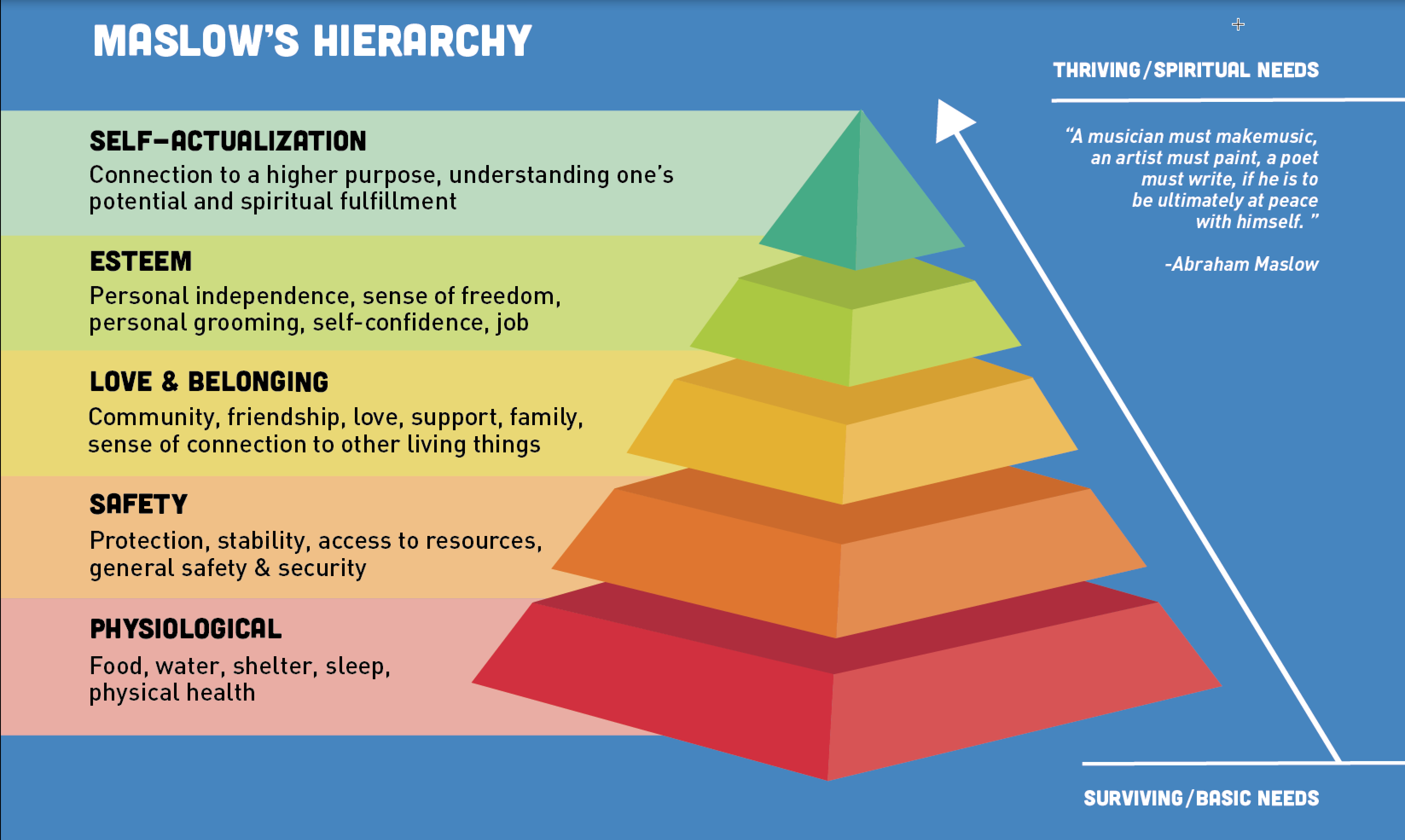
In 1943, psychologist Abraham Maslow published a theory of human motivation that would eventually become one of the most recognizable diagrams in the world: a five-level pyramid, rising from basic survival at the base to something Maslow called self-actualization at the peak.
Most people know the shape of it even if they’ve never read a word of the original paper. Physiological needs at the bottom. Then safety. Then love and belonging. Then esteem. Then, at the top, self-actualization — becoming the fullest version of what a person is capable of being.
It’s a genuinely elegant idea, and it explains something real: needs are layered, and unmet needs at a lower level tend to hijack a person’s attention no matter how much progress they’ve made higher up. A person who hasn’t slept in two days isn’t thinking about their five-year plan. A person drowning in debt isn’t primarily occupied with creative self-expression.
But here’s what the diagram never tells you, and what Daniel discovered the hard way: reaching the top of the pyramid on paper — financial security, a stable marriage, professional respect — doesn’t automatically mean you’re standing where you think you are. The pyramid describes the shape of human need. It was never built to tell you, specifically, where the gaps in your own life actually are, or what to do about them on a Tuesday.
That gap between elegant theory and practical action is where most people quietly get stuck. It’s also exactly the gap Acumentor’s 10 Life Segments Model was built to close.
A Fast, Honest Recap of the Five Levels
Before mapping the two frameworks together, it’s worth walking through Maslow’s levels the way they actually show up in a life, not just in a textbook diagram.
Physiological Needs — food, water, sleep, physical safety in the most literal sense. When these aren’t met, nothing else gets a person’s real attention. The body always negotiates first.
Safety Needs — financial stability, physical security, predictability. This is the layer where a person quietly asks, am I going to be okay? Without an answer, anxiety fills the space ambition should occupy.
Love and Belonging — friendship, intimacy, family, community, the felt sense of being understood. Maslow considered loneliness here to be a genuine unmet need, not a minor discomfort.
Esteem — both self-respect and recognition from others. When this layer is unmet, ordinary setbacks start to feel like referendums on a person’s worth.
Self-Actualization — the desire to become the fullest expression of what a person is capable of. Not a finish line. A direction.
Maslow himself was clear that these levels aren’t rigid, sequential floors a person completes one at a time. They run simultaneously, tangled into each other — which is exactly why a person can look, from the outside, like they’ve cleared every level, and still lie awake at 4:12 a.m. with an unnamed ache the diagram has no vocabulary for.
Where Acumentor’s 10 Life Segments Pick Up the Thread
Acumentor’s framework breaks life down into ten interconnected areas that, assessed and developed together, create the conditions for genuine, sustained growth:
- Lifestyle & Habits
- Professional & Career Growth
- Leisure & Work-Life Balance
- Mental & Emotional Health
- Physical Health & Wellness
- Financial Freedom
- Social & Relational Success
- Spiritual & Purpose-Driven Growth
- Creative Growth
- Intellectual Growth
At a glance, this looks like a practical checklist. It is one. But laid alongside Maslow’s pyramid, something else becomes visible — a structural echo, level by level, of the same human needs Maslow first mapped eighty years ago.
Physiological needs show up in Physical Health & Wellness and Lifestyle & Habits — the daily, unglamorous inputs of sleep, movement, and routine that everything else is quietly built on top of.
Safety needs show up in Financial Freedom and Leisure & Work-Life Balance — not just having money, but having a sustainable rhythm that doesn’t quietly bankrupt a person’s health or attention in exchange for stability.
Love and belonging show up in Social & Relational Success and Spiritual & Purpose-Driven Growth — belonging to people, and belonging to something larger than the self.
Esteem spreads across Professional & Career Growth, Mental & Emotional Health, and Intellectual Growth — because self-respect, it turns out, is rarely built by achievement alone. It’s built by competence, emotional stability, and a mind still actively engaged with the world.
Self-actualization — the level almost everyone assumes they’re aiming for — spreads across Creative Growth, Spiritual & Purpose-Driven Growth, and Intellectual Growth: the pursuit of growth for its own sake, not because a deficiency needs fixing, but because becoming is its own reason.
Six insights fall out of laying these two frameworks side by side, and the second one is the uncomfortable one worth sitting with.
What the Mapping Actually Reveals
Holistic growth isn’t a wellness trend — it’s a structural necessity. Neglect any one segment for long enough, and the strain shows up somewhere else entirely, often in a domain that looked perfectly solid.
Most people believe they’re working on self-actualization while quietly still managing unresolved needs from the middle of the pyramid. This is the one that catches high performers off guard most often. A person can have genuinely excellent finances and a stable home and still be running on unresolved esteem gaps, or a threadbare sense of purpose, because the feeling of emptiness that shows up after “success” isn’t always about ambition — sometimes it’s a segment that never got assessed in the first place.
A gap isn’t a failure — it’s navigational data. Maslow’s pyramid was descriptive, not a report card. Neither is an honest life assessment.
Neither framework is actually linear in practice. People work on two or three segments at once, not ten in sequence — which is closer to how real growth happens than any clean diagram suggests.
The body is the beginning, not the afterthought. Ambitious people are especially prone to deferring physical health until “later,” treating it as negotiable. Both frameworks agree: it isn’t.
Purpose sits at two levels at once. It’s a belonging need and a self-actualization need simultaneously — which is exactly why a threadbare sense of purpose can quietly destabilize a life that looks, on a spreadsheet, entirely secure.
The Practical Question the Pyramid Was Never Built to Answer
Here’s the conversation Maslow’s diagram cannot have with anyone: you’ve identified a gap — now what, specifically, do you do about it next Tuesday?
The pyramid stays silent there. That silence is exactly where Daniel Foster got stuck, and it’s where an Acumentor mentor eventually met him — not with reassurance that his list was fine, but with a structured 360° assessment across all ten life segments, designed to surface not what he assumed about his own life, but what his actual habits and patterns showed.
The results reframed the entire eighteen months of 4:12 a.m. wakeups in about four minutes. Daniel’s Financial Freedom and Professional Growth segments scored exactly as high as his spreadsheet suggested — no surprise there. But Spiritual & Purpose-Driven Growth scored lower than almost anything else on the assessment, and Creative Growth barely registered at all. Two segments that had been quietly starved for over a decade, hidden entirely behind levels of the pyramid he’d already “completed.”
Nothing on his list had been wrong. It had just been incomplete in a place the list itself had no way of showing him.
From Diagram to Roadmap
What followed wasn’t a dramatic life overhaul. It was a 90-day roadmap built around the two segments the assessment had flagged — small, sequenced, and specific in a way the pyramid never could be: a weekly non-negotiable block of time with no professional purpose attached to it, a return to a woodworking hobby he’d abandoned during his kids’ college years, and a single recurring question his mentor gave him to ask at the end of each week — did anything I did this week matter to me beyond its usefulness?
By the ninety-day mark, the 4:12 a.m. wakeups had mostly stopped. Not because anything external had changed — the company, the marriage, the mortgage, all exactly as they’d been — but because the part of the pyramid Daniel had assumed was optional turned out to be the part his mind had been quietly waiting on the whole time.
He still keeps spreadsheets. He just doesn’t mistake them for the whole picture anymore.
No Level Is Optional
Both frameworks agree on something most personal development advice quietly ignores: there’s no dimension of a full life that’s safe to permanently deprioritize. You can’t decide relationships don’t matter and expect belonging needs to resolve themselves. You can’t defer physical health indefinitely and expect the foundation underneath everything else to hold. You can’t treat purpose or creativity as luxuries for people with more free time and expect self-actualization to arrive on its own schedule.
This doesn’t mean every segment demands equal attention every week. It means sustained neglect of any one of them creates a gap that quietly limits everything built on top of it — often in ways that don’t show up until years later, in a feeling with no obvious cause and a spreadsheet that insists everything is fine.
Maslow Built the Theory. The Map Is What Comes Next.
Maslow spent decades studying the most fully functioning people he could find, trying to understand what thriving actually looked like from the inside. What he found wasn’t that they’d simply worked harder or wanted more. It was that they’d attended, with real intentionality, to the full range of human need — not just the parts that were visible on a resume or rewarded by other people’s approval.
Eighty years later, that insight still holds. What’s changed is that it no longer has to stay theoretical. A structured assessment across all ten life segments can show, specifically, where a hierarchy that looks complete on paper actually has quiet gaps — and a personalized roadmap can close them one segment at a time, long before the gap turns into a 4:12 a.m. question with no obvious source.
Maslow gave the world the pyramid. What comes after it is the map.
If parts of your own life look complete on paper but don’t quite feel that way, Acumentor’s free Success Path Assessment evaluates all 10 life segments and builds a personalized roadmap for the gaps that don’t show up on a spreadsheet.