For fourteen months, Daniel started every morning the same way. He stood at the bathroom mirror, looked at an index card taped to the glass, and read it aloud: Money comes to me easily and abundantly. Then he brushed his teeth and went to work.
And something did change. A promotion came through in the spring, then a second title adjustment that pushed his salary from roughly $68,000 to just over $91,000. His wife, Emily, joked that the card had a better track record than his last three financial advisors. Daniel laughed along, but privately he was troubled by something he couldn’t explain.
By the twenty-fifth of every month, their checking account hovered close to zero. Not sometimes. Every single month, for fourteen months, without exception. He went through the statements line by line. No fraud, no hidden fees, no single big purchase he could point to. The money arrived, and then it simply seemed to leave.
He did what many people in his position do. He blamed himself. Somewhere he had read that when affirmations “don’t fully work,” it’s because a hidden belief is blocking them. So he added a second card, a private one he told nobody about, and kept saying the words louder. Emily started asking a question that made him uncomfortable: “If the money’s coming so easily, where is it going?”
It was a fair question, and the answer turned out to have almost nothing to do with money. We’ll come back to Daniel at the end. First, it’s worth understanding the book that put that index card on his mirror, because the story of how it got there says a great deal about what affirmations can do, and what they were never designed to do.
What Is The Game of Life and How to Play It?
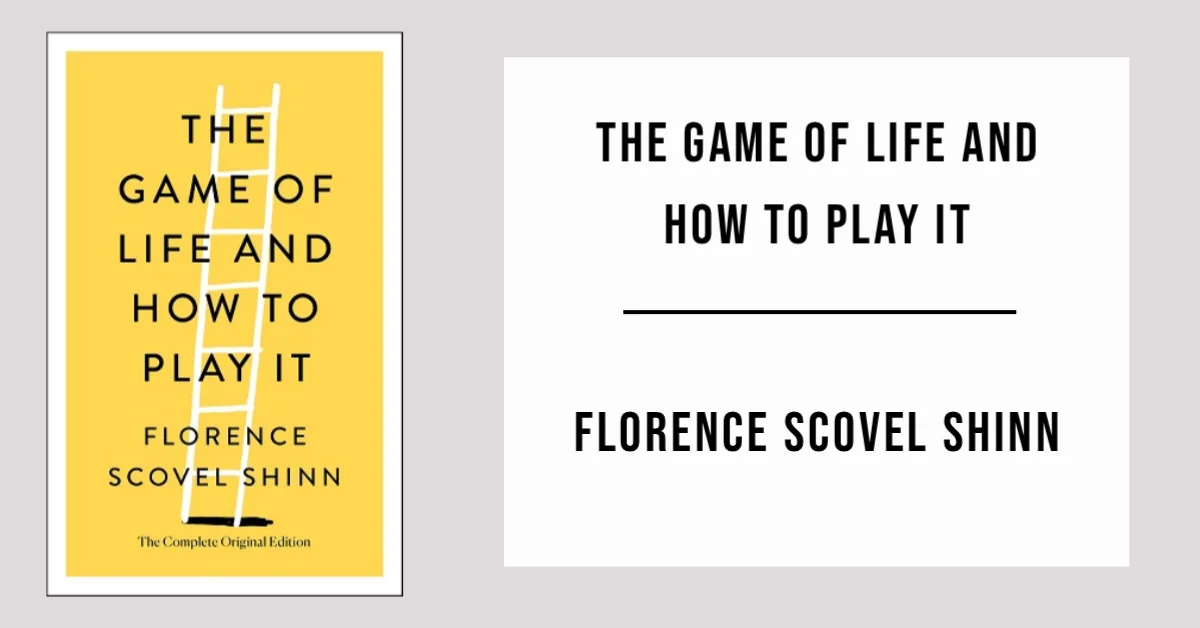
The Game of Life and How to Play It was written by Florence Scovel Shinn and published in 1925. Shinn was an American artist and illustrator who, somewhere along the way, became a spiritual teacher and counselor in New York, working with individual clients and running a modest following through lectures and private sessions. The book is short, plainspoken, and packed with small stories drawn from her practice: a man stuck in a job he hated, a woman who couldn’t stop resenting a relative, a household drowning in debt.
Its central idea is simple enough to say in a breath. Shinn described life as a game of giving and receiving, and she argued that the rules of that game are set by what we think, say, and expect. Thoughts and words, in her telling, are creative forces. What you consistently say about your situation, especially out loud, gradually shapes the situation itself. Whatever you send out returns to you, often with surprising accuracy, which is why she liked to compare life to a game of boomerangs.
From there, the book moves through a handful of practical ideas:
- The power of the spoken word. Short, positive, present-tense statements, which we now call affirmations, are treated as the main working tool.
- Denials and affirmations. Shinn paired a statement of what you no longer accept with a statement of what you do accept, a technique she used to “erase” old mental pictures.
- The law of non-resistance. Rather than fighting a problem, she advised calm acceptance and refusing to feed it with fear.
- Forgiveness and release. Resentment, she argued, keeps a person tied to exactly the situations they want to leave.
- Intuition and guidance. Ordinary decisions, she believed, are easier when a person learns to listen for an inner “hunch.”
- Divine design. Every person, she taught, carries a personal ideal for their life, expressed through health, prosperity, love, and meaningful work, and the goal is to stop obstructing it.
The language is rooted in religion, which is part of why it landed so strongly with readers of her time. Modern readers from other backgrounds can easily translate it into whatever framework of purpose or higher meaning they already hold, and the book still reads well.
Why This Book Mattered So Much
It’s tempting to say Shinn invented affirmations. She didn’t, and it’s worth being accurate about that. The ground had been prepared well before 1925 by the New Thought movement and its writers. The correspondence course that quietly shaped so much of the industry had been circulating since 1912, and other authors of the era were already writing about visualization, autosuggestion, and the power of focused thought.
What Shinn did was different, and arguably more influential in the long run. She took the abstract philosophy and turned it into something an ordinary person could use before lunch.
She made the practice short and speakable. Earlier writing on the subject tended to be dense and philosophical. Shinn handed readers actual sentences to say: brief, specific, and tied to real situations like a lost job, a broken friendship, or an unpaid bill. That “here’s the exact line” format is the direct ancestor of the affirmation cards, journaling prompts, and morning scripts that fill today’s wellness culture.
She made it personal and story-driven. Her case-style anecdotes turned an idea into something you could picture happening to a neighbor. It’s a technique modern authors still use, and it’s a big part of why the book has stayed in print for a century.
She widened the goal beyond money. Many writers of the time framed the whole thing as a way to get rich. Shinn talked about health, love, forgiveness, and self-expression alongside prosperity. That was a meaningful step toward the idea that a good life has more than one dimension.
She helped set the template for the manifestation wave that followed. Books like Think and Grow Rich and The Power of Positive Thinking arrived later, and the early-2000s law-of-attraction boom repackaged many of the same principles for a new generation. Anyone who has looked at how a focused, intentional mindset can lift productivity and creativity is working with ideas Shinn helped bring to everyday readers.
So while the accurate description is not “the book that invented affirmation,” it is fair to say it is one of the books that carried affirmation and manifestation out of philosophy circles and into ordinary life. Both halves of that sentence matter.
What the Book Got Right
A fair look at a hundred-year-old book has to start with what still holds up.
The first thing is ownership. Shinn’s whole approach rests on the idea that you are not merely a passenger in your circumstances. Even when you can’t control events, you have real say over how you interpret them and how you respond. That is a healthy starting point for anyone who feels stuck.
The second is attention to language. The way people talk to themselves shapes what they notice and what they attempt. A person who constantly rehearses “I never catch a break” tends to stop scanning for breaks. Shinn understood this intuitively long before cognitive psychology gave it names.
The third is forgiveness as practical hygiene. Her insistence that carrying grudges drains energy and narrows options is something modern emotional research broadly supports, even if the spiritual wrapping differs. Related themes appear in current work on gratitude and its measurable effect on mental health, which points in a similar direction: what a person dwells on changes how their days feel.
And the fourth is calm under pressure. The law of non-resistance, stripped of its wording, is advice to stop adding panic to a problem. That still works.
Where the Book Fell Short
This is where an honest reading has to slow down, because the same simplicity that made the book so usable is exactly what limits it.
It treats the word as the master lever. For Shinn, speaking the right words is the engine and everything else follows. There is very little room in the book for skills, systems, timing, and plain effort. But changing a life almost always involves building capabilities, and that requires understanding the actual distance between where someone’s abilities are and where their goals are. An affirmation can motivate someone to close that distance. It cannot close it on their behalf.
It can drift into blaming the person. If thoughts create circumstances, then difficulties start to look like failures of thinking. Someone dealing with illness, a layoff, or a market crash can end up wondering what they did wrong mentally. That’s a heavy and often inaccurate burden to put on a person.
Affirmations don’t work equally for everyone. Research published in the journal Psychological Science in 2009 found that repeating positive self-statements helped people with high self-esteem a little, but tended to make people with low self-esteem feel worse. When a statement is too far from what a person actually believes, the mind argues back. Many of those beliefs were installed long ago, which is why the false messages absorbed in childhood deserve attention before any script gets layered on top of them.
It leans on testimonials. The book is full of success stories. That’s persuasive, but stories that get retold are the ones where it worked. The people who said the words faithfully and saw nothing happen don’t get a chapter, a familiar problem explored in depth in how success stories quietly filter out the failures.
It offers no way to know where to start. Shinn tells a reader to affirm health, prosperity, love, and self-expression, but she provides no method for diagnosing which area is actually the weakest, or how one area is quietly affecting another. The person is left to guess, and guessing is exactly how a strong area gets over-polished while a weak one keeps causing trouble. This is the classic pattern behind the idea that a chain is only as strong as its weakest link.
Her view of relationships can push people toward tolerating too much. Forgiveness and non-resistance are valuable, but without a way to tell meaningful relationships from toxic ones, “don’t resist” can quietly become “don’t set boundaries.”
It covers only part of a whole life. Shinn’s divine design touches health, wealth, love, and self-expression. That’s roughly four pieces of a much larger picture. Career skill-building, intellectual growth, daily habits, work-life balance, emotional awareness, creativity, and a sense of purpose are barely visible, and yet each one can make or break the others.
Where Acumentor’s Framework Picks Up
The Game of Life and How to Play It gives a reader a strong opening move. Acumentor’s approach is built around the idea that a game this big needs a full board.
Its framework maps life across ten interconnected areas: professional and career growth, financial freedom, intellectual growth, creative growth, habits and lifestyle, self-care, mindfulness and emotional awareness, social and relational success, work-life balance, and spiritual purpose and awareness. Instead of assuming everyone should start with the same affirmation, it begins by asking where a person really stands in each area, then builds a roadmap around the gaps. It’s the same logic behind the observation that life behaves like a jigsaw puzzle with ten pieces, where one missing piece changes the whole picture, and behind the broader argument that a single formula was never going to fit everyone.
Put simply, Shinn’s book is strongest on the inner game: attitude, language, release, and trust. Acumentor’s framework adds the rest of the board: measurement, balance across areas, and a specific plan for each.
How to Play the Game Today: A Practical Way to Use What Works
If you want to keep the useful parts of Shinn’s approach without inheriting its blind spots, here is a sensible way to do it.
1. Pick one area, not everything at once. Choose the part of life that is currently the weakest, not the one that feels most exciting. A quick look at which priorities are actually carrying the weight can save months of effort in the wrong place.
2. Write an affirmation you can actually believe. “I am becoming someone who reviews my finances every Sunday” will hold up better than “I am fabulously wealthy” if your current reality disagrees loudly. The statement should stretch you, not insult you.
3. Attach a behavior to every statement. Every affirmation should have a small action beside it. The link between saying and doing is where change happens, and it’s why small daily improvements compound into large results far more reliably than repetition alone.
4. Give it a timeframe and a check-in. Ninety days is long enough to see movement and short enough to stay honest. Structuring effort into focused windows, the way a twelve-week execution cycle does, keeps the practice from turning into a comforting ritual with no results attached.
5. Watch the small decisions. No affirmation survives a hundred contradictory choices. Outcomes are shaped less by grand declarations than by thousands of small decisions made every day.
6. Balance the areas. Progress in one part of life tends to hold only when the others aren’t working against it, which is the point behind balancing health, wealth, and character.
Back to Daniel and the Mystery of the Vanishing Money
Six weeks after Emily asked her question, Daniel sat down with one of the mentors at Acumentor and, at their suggestion, worked through the Success Path Assessment first. He expected it to confirm what he already believed: that his money mindset needed more work.
The results said something else. Income was not his problem. His Financial Freedom score showed strong earning but almost no structure behind it: no budget, no automatic savings, no regular review of where money went. Meanwhile, three other areas sat quietly at the bottom of his profile: Self-Care, Habits and Lifestyle, and Mindfulness and Emotional Awareness.
The mentor walked him through what that combination often looks like in real life. Daniel was sleeping around five hours a night, skipping meals until mid-afternoon, and running on stress. To recover, he was spending: takeout most evenings, ride-shares when he was too tired to drive, weekend getaways as “resets,” a stack of subscriptions he never used. None of it was extravagant on its own. All of it added up to a steady leak, and every dollar of the raise was being spent on recovering from the job that produced it.
Then came the part that stung. The morning card had done something he never noticed. Because he had repeated for over a year that money flows easily, he had stopped looking at the numbers. Why count something the universe is handling? The affirmation hadn’t blocked his money. It had blinded him to it.
The fix was almost boring. A fixed bedtime. A ten-minute weekly money review. An automatic transfer to savings on payday, before he could spend it. A short plan for the Self-Care area, and a walk in place of the late-night ride-share. He kept the mirror card, but added a line beneath it: I look at my money every Sunday.
Six months later, Daniel and Emily had their first real emergency fund. By the end of the year, the account balance on the twenty-fifth of the month had a comfortable number in it for the first time in over two years.
Shinn’s central instinct, that the way we talk to ourselves matters, was never the problem. It simply needed the rest of the board around it. Anyone who wants to see where their own strengths and weak spots actually sit across all ten areas can begin with the Success Path Assessment, which turns a vague sense that something isn’t adding up into a clear, personal picture to build from.